¡Tu mensaje de bienvenida, twitter o publicidad aquí!

| Suscríbete vía RSS

Showing posts with label Sports. Show all posts

Nov 28, 2010

Raymond Kopa

| 0 comments |

Raymond Kopa (born Kopaszewski, on October 13, 1931 in Nœux-les-Mines, Pas-de-Calais), is a former French football striker, integral to the French national team of the 1950s. He was a great and versatile playmaker, who also scored plenty of goals.

Born into a family of Polish immigrants, Kopa began his professional career at the age of 17 with SCO Angers in France's second level, and was transferred two years later to Stade de Reims, with whom he won French championships in 1953 and 1955. He helped Reims reach the first European Cup final in 1956, which the team lost to Alfredo Di Stéfano's Real Madrid, 4-3.

Kopa was transferred to Real Madrid the subsequent season, where he was soon joined by Ferenc Puskás. At Real Madrid, Kopa won the Spanish league in 1957 and 1958. Kopa also became the first French player to win the European Cup when Madrid defeated Fiorentina 2-0 in the 1957 final. He would go on to be European champion again in 1958 and 1959, the last against former side Stade de Reims, where Just Fontaine played.

In the 1959-60 season, Kopa returned to France to finish his career with Reims, where he won further Championnats in 1960 and 1962. In total, he scored 75 goals in 346 matches in France's top flight, and was given the Ballon d'or by France Football in 1958.

With the France national football team, Kopa scored 18 goals in 45 games between 1952 and 1962. He played in the 1958 FIFA World Cup in Sweden, where the French team finished third, losing to the Brazilian team. He was also voted as the 1958 Best Player of the Tournament and retroactively as the 1954 Best Young Player of the Tournament, being the only footballer to receive both honours.

Kopa was named by Pelé as one of the top 125 greatest living footballers in March 2004.

Aug 31, 2010

Mimis Domazos

| 0 comments |


Dimitris "Mimis" Domazos (Greek: Δημήτρης Δομάζος), (born 22 January 1942) is a retired Greek footballer (central attacking midfielder) born in Ampelokipi, Athens. His nickname is "The General".

Mimis Domazos is considered by many to be the best footballer that Greece has ever produced. He was famed for his very good dribbling ability, his creative passes, especially long passes of pinpoint accuracy, and his leadership. He was Panathinaikos FC team captain for over 15 years. When he retired from playing, in 1980, Domazos was declared the longest-active footballer in the history of Greek football, having played for more than 21 years.

Honours

Panathinaikos:
Greek Championship: 1960, 1961, 1962, 1964, 1965, 1969, 1970, 1972, 1977
Greek Cup: 1967, 1969, 1977
Greek Super Cup: 1970
Balkans Cup: 1978

AEK Athens:
Greek Championship: 1979

Domazos was one of the final torchbearers for the Opening Ceremony of the 2004 Athens Olympic Games

May 29, 2010

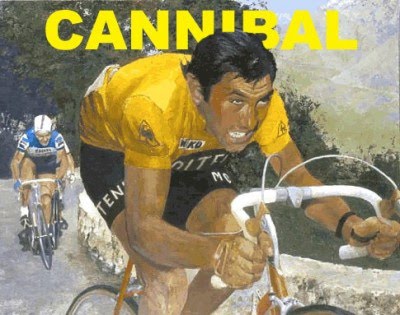
Eddy Merckx, The Cannibal

| 0 comments |

Edouard Louis Joseph, Baron Merckx (born 17 June 1945 in Meensel-Kiezegemin Belgium, better known as Eddy Merckx, is a former professional cyclist. The French magazine Vélo called him "the most accomplished rider that cycling has ever known." The American publication, VeloNews, called him the greatest and most successful cyclist of all time. He won the Tour de France five times, won all the classics except Paris-Tours, won the Giro d'Italia five times and the Vuelta a España, won the world championship as an amateur and a professional, and broke the world hour record. Definately the best cyclist of all times.

May 21, 2010

Marco Pantani, Il Pirata

| 0 comments |

Marco Pantani (January 13, 1970–February 14, 2004) was an Italian road racing cyclist, one of the best climbers in professional road bicycle racing. He won the Tour de France and the Giro d'Italia in 1998. He was known as 'Il Pirata' (the pirate) because of the bandana he wore. His career was beset by drug abuse allegations after a failed blood test in the 1999 Giro d'Italia. He died after a cocaine overdose in 2004.

Pantani was born in Cesena, Romagna. At 1.72m and 57 kg (5 ft 8 in, 126 lb/9 st),Marco Pantani had the classic build for a mountain climber.
Pantani's climbing style was to stay on the lower section of his handlebars, often pedaling out of the saddle. Bianchi built for him a bike with a longer steerer tube for higher handlebars.

During the early evening of 14 February 2004 Pantani was found dead at a hotel in Rimini, Italy. An autopsy revealed he a cerebral edema and heart failure, and a coroner's inquest revealed acute cocaine poisoning. Mario Cipollini said "I am devastated. It's a tragedy of enormous proportions for everyone involved in cycling. I'm lost for words."

Pantani was buried in his hometown, Cesenatico. Twenty thousand mourners were at his funeral.

May 17, 2010

Adidas

| 0 comments |

On August 18th, 1949, Adi Dassler first registered adidas in the commercial register (Handelsregister) in Fürth (near Herzogenaurach). The official name of the company back then was “Adolf Dassler adidas Sportschuhfabrik”. First used in 1949, the 3-Stripes would not stay confined to their birthplace Herzogenaurach but started their victory lap around the world early on to become the most famous symbol and key identifier of adidas.

May 15, 2010

Garrincha (read it all, it is worth it)

| 0 comments |

Garrincha is perhaps the most underrated player ever. Some fans may not have even heard his name before. Yet he is considered among experts to be the best ever even from Pele. He is probably the greatest dribbler of the ball in footballing history.
His crossing abilities and dead-ball skills are also among the best football has ever witnessed.

Born Manuel Francisco dos Santos on October 28, 1933, "Garrincha" was born with several defects. His left leg was six centimetres shorter than his right leg, and curved unnaturally outwards. His right leg bent inwards, and his spine was deformed.

Scouts all over Brazil knew of him, and he was something of a legend between them. Many refused to believe the stories about him until they saw him themselves. One is quoted as saying "there is an unknown player who lives in the woods, has bent legs, is totally un-markable and dribbles like the devil."

Eventually scouts saw him, then believed. His immense talent was showing through at even this young age. However, it took time to convince Garrincha to play professionally. At 19 years old, he signed a contract with Botafogo. He was already married with a child.

In his debut first-team game of his career he scored a hat-trick.

In 1955 he gained his first Brazil cap. He was finally judged to have impressed enough to make it into the national squad and was given his debut against Chile.

For the next few years, Garrincha was in and out of the Brazilian team and continuing to mesmerize the fans with his ball control. In 1957 he helped Botafogo to win the Campeonato Carioca.

The following year he was selected in the Brazilian squad for the 1958 World Cup. However, he was left out of the first two games, reportedly due to his coaches punishing him for irresponsible play in a goal he scored a month previously in a friendly game.

This is one of his most famous goals. He was facing Fiorentina and got the ball, dribbled past four defenders and then the 'keeper. With the goal gaping in front of him, Garrincha didn't put the ball in. He wasn't finished toying with the defenders yet.
He waited for the defence to come back, before dribbling it around another defender and only then did he put them out of their misery.


He was included for the third match of Brazil's World Cup campaign, as was Pele. This would be the first match Garrincha and Pele would play together, a combination that was one of the most feared of all time.

He helped Brazil to a 2-0 win over the USSR. His leg deformities seemed to actually help his football abilities rather than hinder them.

After he gave Welsh fullback Mel Hopkins a torrid time in the quarter final, Hopkins had this to say: "He's a phenomenon, capable of sheer magic. It was difficult to know which way he was going to go because of his legs and because he was as comfortable on his left foot as his right, so he could cut inside or go down the line and he had a ferocious shot too."

In the final Garrincha set up the two Brazil goals which led them to World Cup glory. At the final whistle and the celebrations, Garrincha was reportedly bemused. He thought it was a league competition and they would have to play everyone twice.

Despite his lack of desire to know the "details" of the game, Garrincha was named in the World Cup All-Star team.

He also won silverware with his club in 1958, triumphing in the Oswaldo Cruz Cup. He followed this up with success in the O'Higgins Cup the next year.

However, this was a rare highlight in 1959 for Garrincha. He began drinking more than before, putting on weight and often being found in a drunken state. One night he got into a car drunk, and drove off with an angry mob chasing him. He ran over his father but didn't stop.

When he was later halted, he had no recollection of what had occurred. But his problems off the pitch were soon overshadowed by his performances on it again. In 1961 he won the Campeonato Carioca, the O'Higgins Cup and the Oswald Cruz Cup with Botafogo.

But 1962 was to be his best year. At club level he was simply unplayable, helping his team to another Campeonato Carioca, another Oswaldo Cruz Cup, and a first Torneio Rio-Sao Paulo.

But this was nothing compared to his success internationally. At the World Cup he was on the best form of his career. He was scoring freely, with both feet and his head, and laying on yet more goals.

He was the stand-out performer of the World Cup as Brazil went onto win. Garrincha had won his second consecutive World Cup, and was named Player of the World Cup, World Cup joint Top Scorer and World Player of the Year.

He stayed at Botafogo until 1965, winning another Torneio Rio-Sao Paulo before he left for Corinthians. In his time at Botafogo he scored 232 goals in 581 appearances. He never reached the heights of 1962 again, moving from club to club between 1966 and his eventual retirement in 1973.

Despite this he was named in the 1966 Brazilian World Cup squad. He played two matches, bringing his total number of caps up to 50. His last match for Brazil was against Hungary in which they lost 3-1. It was the first and only game Brazil lost while Garrincha was playing for them.

Pele was not playing in that game, which meant him and Garrincha share a rare record of having never lost when playing together.

Garrincha's story after he retired from football is a tragic one. He became an alcoholic, and was involved in numerous car-accidents, one of which his mother-in-law was killed in. He died on January 19, 1983, aged 49, and the world was left to mourn one of the greatest footballers ever.

Hugely underrated yet immeasurably talented, this has been a tribute to Garrincha.

May 14, 2010

Will Carling

| 0 comments |


William David Charles Carling, OBE (born 12 December 1965) is a former Rugby union player for Harlequins, and a former captain of England from 1988 to 1996, winning 72 caps.
He was the youngest ever England captain at age 22 and was at the time the most successful ever, seeing them to back-to-back Five Nations grand slam victories (1991, 1992), and the final of the 1991 Rugby World Cup.

Playing career
Position Centre
Professional / senior clubs
Years Club / team
Harlequins
National team(s)
Years Club / team
1988–1997
1993 England
British and Irish Lions

Panathinaikos

| 0 comments |


Panathinaikos Sports Club (Greek: Παναθηναϊκός Αθλητικός Όμιλος, Panathinaikos Athlitikos Omilos, i.e. Pan-Athenian Athletic Club) is a sport organisation and the biggest sport club in Greece. It was founded by George Kalafatis in 1908. It is often referred to by its initials, PAO. The club emblem is the three-leaf clover in green.
Over the years Panathinaikos has established departments in 24 different sports, with some of them being inactive at present. Overall these are or were:

Panathinaikos A.C. (PAO)

Established 1908
Club colours Green and white

Websites Football: http://www.pao.gr/
Basketball: http://www.paobc.gr/
Volleyball: http://www.paovolleyball.gr/
Amateur departments:
http://www.panathinaikos1908.gr/
Football, established in 1908

Athletics (track and field), established in 1919
Volleyball, established in 1919
Basketball, established in 1922
Table tennis, established in 1924
Cycling, established in 1928
Shooting, established in 1928
Field hockey, established in 1928 (inactive)
Swimming, established in 1930
Water Polo, established in 1930
Handball, established in 1930 (inactive)
Boxing, established in 1946
Diving, established in 1947
Chess, established in 1959
Weightlifting, established in 1959
Fencing, established in 1960
Gymnastics, established in 1962
Waterskiing, established in 1963 (inactive)
Wrestling, established in 1965
Modern pentathlon, established in 1978
Judo, established in 1980 (inactive)
Archery, established in 1981
Futsal, established in 1990
Synchronized swimming, established in 1992

The Power Of Music