

9 months ago
May 29, 2010
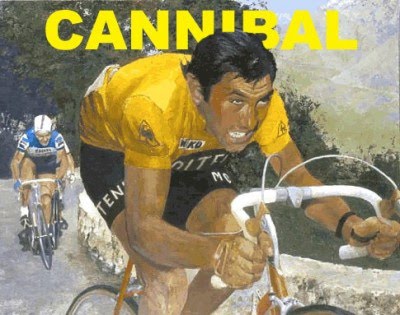
Eddy Merckx, The Cannibal
|
0
comments
|
Labels:
Sports
Edouard Louis Joseph, Baron Merckx (born 17 June 1945 in Meensel-Kiezegemin Belgium, better known as Eddy Merckx, is a former professional cyclist. The French magazine Vélo called him "the most accomplished rider that cycling has ever known." The American publication, VeloNews, called him the greatest and most successful cyclist of all time. He won the Tour de France five times, won all the classics except Paris-Tours, won the Giro d'Italia five times and the Vuelta a España, won the world championship as an amateur and a professional, and broke the world hour record. Definately the best cyclist of all times.
May 28, 2010
Carlos Mavroleon - Κάρλος Μαυρολέων
|
0
comments
|
Labels:
Politics

May 23, 2010
The Black Dahlia Murder
|
0
comments
|
Labels:
General

Elizabeth Short(July 29, 1924 – ca. January 15, 1947) was an American woman and the victim of a gruesome and much-publicized murder. She acquired the nickname Black Dahlia after moving to California. Short was found mutilated, her body severed at the waist, on January 15, 1947 in Leimert Park, Los Angeles, California. Short's unsolved murder has been the source of widespread speculation along with several books and film adaptations.
The body of Elizabeth Short was found on January 15, 1947, in a vacant lot located in the Leimert Park area of Los Angeles near 39th Street and Norton Avenue. Her severely mutilated body had been severed at the waist and drained of blood and her face was slashed from the corners of her mouth toward her ears. She had been "posed" with her hands over her head and elbows bent at right angles. The autopsy stated Short was 5 feet 5 inches (1.65 m), weighed 115 pounds (52 kg), had light blue eyes, brown hair, and badly decayed teeth.
Short was buried at the Mountain View Cemetery in Oakland, California. After her other sisters had grown and married, Short's mother moved to Oakland to be near her daughter's grave.

May 21, 2010
Artem Mikoyan (1905-1970)
|
0
comments
|
Labels:
Education

He completed his basic education and took a job as a machine-tool operator in Rostov. Then in "Dynamo" factory in Moscow. He was conscripted into the military.
In 1940 under the leadership of Artem Mikoyan jointly with Mikhail Gurevich MiG-3 fighter was created.
Artem Mikoyan was a genius who brought glory to his country. The whole world uses his inventions . He was recognized as a great aircraft designer not only in his Motherland, but also abroad.
MiGs have been in the armament of air forces, Soviet and foreign, for over 50 years. Mikoyan's fighters showed 55 world records.
Artem Mikoyan died on 9 December 1970.
Ernesto 'Che' Guevara
|
0
comments
|
Labels:
Politics

Date of Death: 9 October 1967, La Higuera, Bolivia (executed by firing squad)
Nickname: El Fuser-Che
Height: 5'11½" (1.82 m)
Ernesto Guevara de la Serna was born to a middle-class family in Rosario, Santa Fe Province, Argentina on June 14, 1928. Disgusted by the corrupt Argentine militarist government, Guevara became a dedicated Marxist while still in his teens. As a student, he vowed to dedicate his life to revolutionary causes and in 1953 he received a medical degree from the University of Buenos Aires. He left Argentina later that year to take part in a Communist revolt in Guatemala. There he adopted his revolutionary nickname, nom de guerre Che, the local slang for "pal." When the revolution in Guatemala failed the following year, Che fled to Mexico where he was introduced to another Communist revolutionary in exile, Fidel Castro. Joining Castro's July 26 Movement, named after the date of Castro's aborted 1953 revolution in Cuba, Che Guevara sailed with Castro and over 80 guerrilla troops to Cuba where they landed on December 2, 1956, bent on overthrowing General Fulgencio Batista's government. After the invasion force was almost decimated by government troops and air strikes, Castro, Guevara and about 10 others hid out on the Sierra Mastera mountains of southern Cuba. In July 1957, Che was assigned command of half of Castro's forces with the rank of Comandante, a title he shared only with Castro himself. For the next year and a half, he led his insurgents against the government forces in the province of Las Villas, while growing hatred to Batista's government fueled widespread support to Castro's forces, which steadily grew in size. Che's successful attack against the government troops in Santa Clara in December 1958 sealed the victory of Castro's forces. Batista's fled into exhile on January 1, 1959 and Castro's troops then marched unopposed into Havana a week later. After Castro assumed power, Che became one of his most trusted advisors and a leading international revolutionary. Che became the Cuban minister of agriculture and in 1960 wrote a book titled "Guerilla Warfare," a manual for Third World insurgents as part of his plan to bring Communism throught the world. Che resigned his post in Cuba in 1965 and traveled widely to Africa and other insurgent hot spots in the world, including the Belgian Congo, to organize Communist revolts as well as train Cuban contingents there and teach them the French colonial language. In November 1966, Che surfaced in Bolivia to organize another revolt by the local Communist peasants. But the revolution in Bolivia only received lukewarm support from many of the poorly-educated, non-Spanish-speaking peasants who preferred to support the government, not caring for foreign insurgents. After a long and drawn out campaign, Che's revolt in Bolivia came to an abrupt end on October 7, 1967 when he and the surviving members of his group were captured by government Bolivian soldiers. Two days later, on October 9, 1967, Che was executed by a Bolivian firing squad, who were apparently acting under orders from the CIA which were training the Bolivian army.
Subscribe to:
Posts (Atom)
About Me
My Blog List
-
-
1 year ago
-
-
10 years ago
-
12 years ago


